Here’s the thing about hiking Acatenango Volcano in Guatemala: the timing can make a difference in your experience.
You’re climbing a volcano to watch another volcano erupt across the valley. If you’re lucky, you’ll spend the evening watching glowing lava light up the night sky, wake up to a beautiful sunrise, and wonder how a place like this even exists. It’s hands down one of the most epic adventures in over a decade of travels.
I hiked Acatenango in November, and honestly, it was perfect timing for me. November marks the beginning of Guatemala’s dry season, and one of our guides told us that November through early December can be an excellent window for those incredible sunset views over Volcán de Fuego. He was right!
I’ve done plenty of challenging mountain hikes, and Acatenango still pushed me harder than I expected. I arrived in Antigua the night before, packed way too much camera equipment, underestimated the physical demands, and ended up sick at camp after a long day on the mountain.
Would I do it again? Absolutely. Would I plan it differently? One hundred percent.
In this guide, I’m breaking down the best time to hike Acatenango Volcano, what each month is like, when you have the best chance of seeing Fuego erupt, and what I’d recommend based on my experience.
If you’re planning your first Guatemala volcano adventure, here’s what you need to know.
Acatenango Volcano: Quick Facts
Before we get into the best months, here’s what you should know about the hike.
Location: Near Antigua, Guatemala
Elevation: Approximately 13,045 feet (3,976 meters)
Elevation gain: Around 5,000 feet (1,500 meters), depending on the route
Distance: Approximately 8–9 miles round trip for a typical trek, depending on the itinerary
Duration: Usually two days and one night
Difficulty: Strenuous
Main attraction: Views of Volcán de Fuego erupting across the valley
Best season: November through April
Most hikers spend the first day climbing from La Soledad to base camp, where they sleep overnight before descending the following morning. Optional excursions may include a sunset hike toward Fuego or a pre-dawn hike to Acatenango’s summit.
Not every itinerary includes the same activities, and conditions may affect what your guide allows.
Is Acatenango worth it? Absolutely. But it isn’t a casual walk with a pretty view at the end. You need to prepare, pace yourself, and respect the mountain.
What Is the Best Time to Hike Acatenango Volcano?
The best time to hike Acatenango Volcano is generally November through April, during Guatemala’s dry season. During these months, rainfall tends to be lower, trails are often drier, and you generally have a better chance of seeing Volcán de Fuego and the surrounding volcanic landscape.
If seeing Fuego erupt is your main reason for doing this hike, I’d prioritize the dry season. November and early December are particularly worth considering, based on my own experience, while January and February can also offer excellent visibility.
But here’s the catch: no month guarantees clear skies.
Weather in the mountains can change quickly. You might have beautiful sunshine during the climb and find yourself surrounded by clouds a few hours later. Even in the dry season, wind, cold temperatures (which is very common at base camp), and poor visibility are possible.
Here’s a quick breakdown:
Best overall season: November through April
Months worth prioritizing for dry-season visibility: November through February
Good alternatives: March and April
Rainy season: May through October
Months with a higher risk of persistent rain and cloud cover: June through September
These are general seasonal patterns, not guarantees. Your experience will depend on the weather during your actual hiking dates.
Understanding Guatemala’s Dry and Rainy Seasons
Guatemala has two main seasons that influence the Acatenango hiking experience: the dry season and the rainy season.
The Dry Season: November to April
The dry season is generally the best time to hike Acatenango. Rainfall tends to decrease, trails are less muddy, and the chances of getting clear views of the surrounding volcanoes improve.
This matters because the nighttime views are a huge part of the experience. Most travelers are not climbing Acatenango just to reach a campsite. They’re there to watch Fuego erupt across the valley, ideally with the sky dark enough to see the glowing lava against the night.
When conditions are good, it’s absolutely surreal.
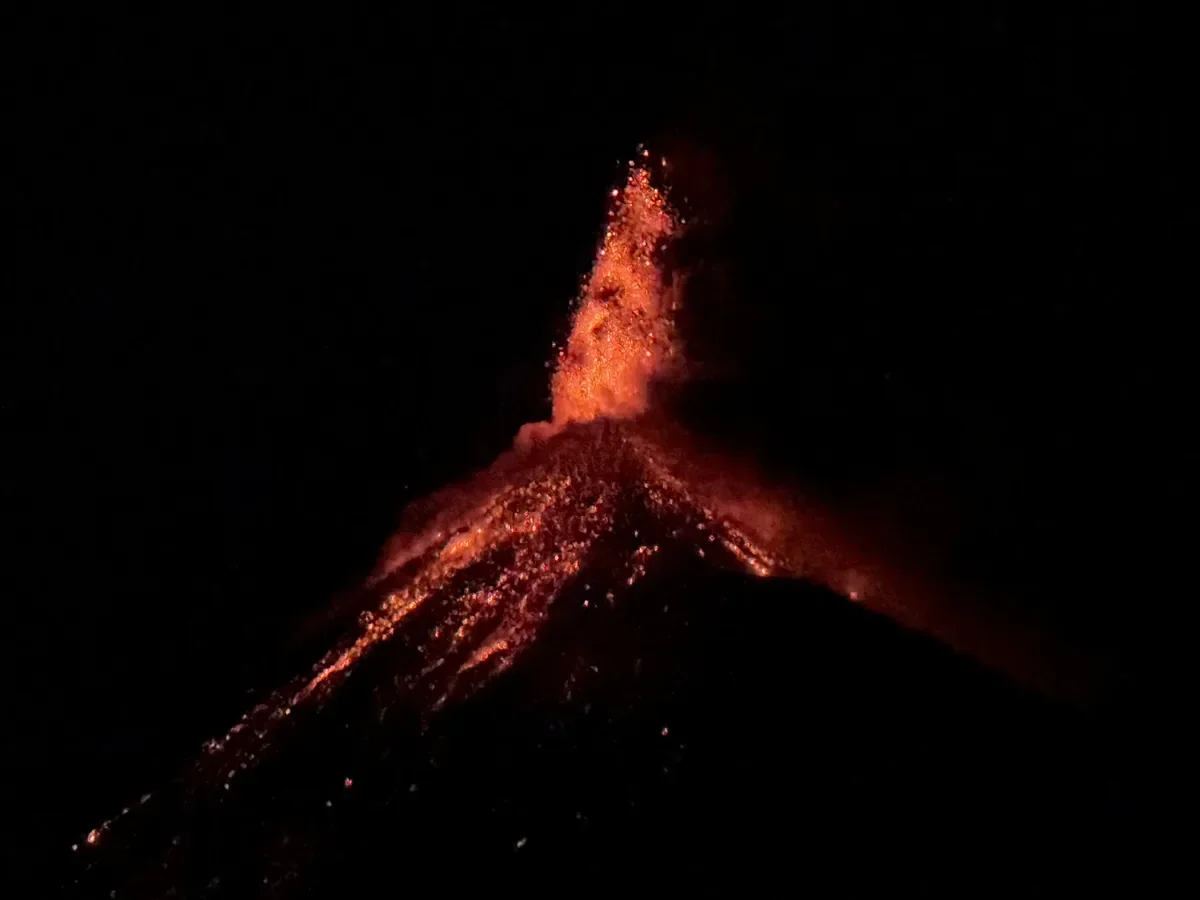
Volcano erruption from base camp captured by a Trekking Pals traveler
The dry season is also a popular time to visit Guatemala, so you should book your accommodation and hike in advance, especially around Thanksgiving, Christmas, New Year’s, and Easter.
The trail can get really crowded around these times, so be prepared to share the trail and practice trail etiquette.
One thing people sometimes overlook is how cold it gets at altitude. Don’t assume that because Antigua feels warm during the day, you’ll be comfortable at base camp overnight. Temperatures can approach or fall below freezing at base camp, especially with the strong winds.
Make sure that you are packing enough layers, a warm fleece jacket, a windbreaker, a beanie, and gloves.
The Rainy Season: May to October
The rainy season is a different story. The landscape becomes greener, the cloud forest feels lush, and the mountain can look dramatic as clouds move across its slopes.
But rainfall and cloud cover can make the hike more challenging. Trails may become muddy and slippery, and you might reach base camp only to discover that Fuego is hidden behind clouds.
That’s a real possibility when planning a trip around a volcanic viewpoint.
It doesn’t mean hiking Acatenango during the rainy season is impossible or always disappointing. You can still get clear windows, and conditions vary from day to day.
However, I’d be more cautious about choosing these months if I were traveling to Guatemala specifically to see Fuego erupt.
If your dates fall during the rainy season, leave some flexibility in your itinerary and choose an operator that takes weather and safety seriously.
The Best Time to Hike Acatenango, Month by Month
Let’s get into the details. Here’s what I’d consider when choosing your hiking dates throughout the year.
| Month | Weather and Trail Conditions | Views of Fuego | Best For |
|---|---|---|---|
| January | Dry-season conditions, with cold nights and possible freezing temperatures. | Often favorable for clear views, although clouds can still occur. | Hikers prioritizing visibility and drier trails. |
| February | Typically dry, with relatively low rainfall and often dry trails. | Good potential for clear views when weather cooperates. | Travelers seeking favorable dry-season conditions. |
| March | Generally dry, with longer daylight hours and strong sunshine. | Good potential for panoramic views, subject to weather. | Hikers combining Acatenango with other outdoor adventures. |
| April | Often dry earlier in the month, transitioning toward the rainy season. | Potentially excellent earlier in the month. | Travelers seeking late dry-season conditions. |
| May | Transition toward the rainy season, with increasing showers and cloud cover. | More variable; clouds may obscure views. | Flexible travelers. |
| June | Rainier conditions, with muddy trails and more challenging hiking. | Cloud cover can limit visibility. | Travelers with fixed dates who accept weather uncertainty. |
| July | Rainy-season conditions, with wet and muddy terrain possible. | Clear periods are possible, but rain may interfere. | Adventurers comfortable with unpredictable weather. |
| August | A mix of rain, clouds, and occasional clear periods. | Highly dependent on conditions during your hike. | Travelers with flexible expectations. |
| September | Typically one of the wetter months, with muddy trails. | Rain and clouds may reduce visibility. | Travelers unable to change their dates. |
| October | Transition toward the dry season, although rain may persist. | Variable, with possible improvement later in the month. | Flexible travelers seeking shoulder-season conditions. |
| November | Beginning of the dry season, with improving conditions but possible early rain. | Potentially excellent sunset views when skies are clear. | Travelers seeking improving weather and time to explore Antigua. |
| December | Dry-season conditions, with cold nights at altitude. | Good potential for sunset and nighttime views when skies are clear. | Holiday travelers prioritizing dry-season conditions. |
This is a general seasonal guide, not a guarantee of visibility. Weather varies, and clouds, rain, wind, and volcanic activity can affect conditions in any month.
What Is the Best Time of Day to See Fuego Erupt?
Choosing the right month improves your chances, but the time of day also matters. Most overnight Acatenango hikes begin in the morning. You’ll spend several hours climbing to base camp, where you can rest before sunset and nighttime viewing.
Acatenango Sunset: One of the Highlights
Sunset is one of the best parts of the experience when the skies are clear. The surrounding volcanoes become silhouettes, the sky changes color, and you get your first chance to watch Fuego against the evening sky.
Some tour operators offer an optional hike toward Fuego in the afternoon or evening. This is a strenuous excursion that involves descending into the valley between the volcanoes before climbing back up.
You’re already tired from the initial climb, and you’ll be hiking at altitude over steep terrain and loose volcanic rock. When I did the optional sunset hike, I was exhausted, but I’m glad I went. Watching Fuego erupt from much closer was one of the most memorable parts of my trip.
However, this excursion isn’t suitable for everyone, and your guide should assess the group’s condition and current safety considerations before proceeding.
Acatenango Nighttime: The Main Event
For many people, nighttime is the reason to hike Acatenango. When Fuego erupts after dark, glowing volcanic material can be visible against the night sky. You may also hear eruptions echoing across the valley.
It’s an incredible experience, but volcanic activity is unpredictable. You cannot guarantee a particular eruption, and clouds can block your view even when Fuego is active.
Acatenango Sunrise: Is It Worth Waking Up at 4 AM?
Many overnight tours offer an optional early-morning hike toward Acatenango’s summit.
The wake-up call can be around 3:30–4:00 AM, depending on the operator. You’ll hike in darkness, often in freezing temperatures, over steep sections of loose volcanic scree.
I intended to do the sunrise summit hike, but I ended up skipping it because I felt too rough after getting sick during the night. Several other people in my group made the same decision.
If you’re feeling well and conditions are safe, the sunrise can be spectacular. But you don’t need to summit to enjoy the experience. Watching the sunrise from base camp can still offer beautiful views.
Listen to your body, especially at altitude. Reaching the highest point isn’t worth putting your health at risk.
How Weather Can Affect Your Acatenango Experience
Choosing the right month is important, but there are a few other factors worth understanding.
Cloud Cover and Visibility
Clear skies improve your chances of seeing Fuego and the surrounding volcanoes. However, clouds can move in quickly, especially during the rainy season. Sometimes the weather improves after sunset; sometimes the mountain stays covered.
You can plan carefully, but you can’t control the weather.
Rain and Trail Conditions
The Acatenango trail is steep, with loose volcanic gravel that makes footing challenging even in dry conditions.
Rain can make the trail muddy and slippery, particularly through forested sections. The descent can be just as challenging as the climb because of the loose ground and steep slopes.
Trekking poles are particularly useful for maintaining balance on the way down.
Cold Temperatures at Base Camp
Don’t pack based on the weather in Antigua.
Antigua sits at a much lower elevation than Acatenango’s summit and base-camp areas. Temperatures can approach or fall below freezing overnight, especially in exposed, windy locations.
Bring warm base layers, an insulated jacket, gloves, a beanie, and protection against wind and rain. Ask your operator what sleeping equipment is included.
Wind and Exposure
Wind can make the summit feel considerably colder than the actual air temperature. The upper mountain is exposed, and conditions can change rapidly. A windproof outer layer is essential.
If your guide advises against an exposed section or an optional excursion because of the weather, take that advice seriously.
How to Prepare for Acatenango, Regardless of the Season
One of the biggest lessons from my hike was that preparation matters just as much as choosing the right month.
Arrive in Antigua at Least One Day Early
This is a mistake I made, and I wouldn’t repeat it.
I arrived in Antigua the night before my hike. I was tired, under-rested, and hadn’t given myself enough time to adjust to the elevation.
Antigua itself sits at around 5,000 feet, which is already higher than many travelers are accustomed to. Acatenango takes you much higher.
I’d recommend arriving at least a full day before the hike, prioritizing sleep, drinking enough water, and giving yourself time to settle in.
One day doesn’t guarantee protection against altitude illness, but rushing into a strenuous climb after a long flight is not a good plan.
Don’t Pack Like You’re Filming a Documentary (unless you are)
I brought a drone, a tripod, and extra filming equipment that I barely used. Add several liters of water to that, and my backpack was much heavier than it needed to be.
Every extra pound mattered during the steep climb.
If you’re bringing camera equipment, think carefully about what you’ll actually use. Consider hiring a porter if you need help carrying extra weight.
The experience is more important than getting every possible shot.
Train Before You Go
You don’t need to be an elite athlete to hike Acatenango, but arriving without preparation makes the climb much harder.
Focus on:
Stair climbing and incline treadmill walking
Hiking with elevation gain
Squats, lunges, and step-ups
Core strength and stability
Gradually training with a loaded backpack
Bring Enough Water, Snacks, and Warm Layers
Check your operator’s packing list and carry the recommended amount of water. Some itineraries recommend approximately four liters because water sources on the mountain are limited.
Bring energy-dense snacks, electrolytes if appropriate, and food you’ll actually want to eat when you’re tired.
Warm layers are essential, even if Antigua is hot when you leave.
Choose Your Tour Operator Carefully
This is another lesson I learned firsthand.
My group had more than 20 people, and everyone moved at a different pace. Some hikers were flying up the mountain while others were struggling with the altitude.
A large group can make it harder for guides to provide individualized attention and for everyone to feel supported.
If I were booking my first hike again, I’d ask about group size, guide-to-hiker ratios, sleeping arrangements, equipment, and weather-related safety policies before paying.
A smaller group or private guide may be worth the extra cost, particularly if you want more flexibility and personalized support.
Know the Signs of Altitude Illness
Headache, nausea, dizziness, fatigue, and loss of appetite can occur at altitude. I experienced several symptoms during my night at camp, along with vomiting and diarrhea.
Don’t assume these symptoms are simply part of the challenge.
Tell your guide immediately if you feel unwell. Severe symptoms, confusion, difficulty walking, or shortness of breath at rest require urgent medical attention and descent with appropriate assistance.
Don’t push through serious symptoms just to reach the summit.
Frequently Asked Questions About the Best Time to Hike Acatenango
What is the best month to hike Acatenango Volcano?
November and early December are worth considering, based on my experience and the seasonal transition toward drier weather. January and February can also offer excellent conditions. Ultimately, the best month depends on your priorities and the weather during your trip.
Is November a good time to hike Acatenango?
Yes. November marks the beginning of Guatemala’s dry season. I hiked Acatenango in November and had a memorable experience despite the fact that it was crowded.
Can you hike Acatenango during the rainy season?
Yes, hikes may be possible during the rainy season when conditions permit. However, trails can be muddy, visibility can be limited, and operators may need to adjust itineraries for safety.
Can you see lava erupting from Acatenango?
You may see glowing volcanic material and eruptions from Volcán de Fuego across the valley. Visibility depends on weather, cloud cover, darkness, and volcanic activity. No operator can guarantee that you’ll see an eruption on a particular night.
How cold does Acatenango get at night?
Temperatures near base camp and the summit can approach or fall below freezing, particularly when it’s windy. Bring proper insulating layers and confirm what cold-weather equipment your tour provides.
How many days do you need for Acatenango?
The standard hike takes two days and one night. I’d recommend arriving in Antigua at least one full day before the trek and allowing time to recover afterward.
Can beginners hike Acatenango?
Yes, some beginners complete the hike successfully, but it is strenuous. Prepare physically, choose a reputable operator, pace yourself, and take altitude symptoms seriously.
Is the sunrise summit hike mandatory?
No. It’s usually optional, depending on your tour. If you’re exhausted, unwell, or facing unsafe conditions, staying at base camp is a perfectly reasonable decision.
Exploring Antigua Guatemala
One of my recommendations is to give yourself time to explore Antigua rather than treating it just as a place to sleep before your hike.
It’s a beautiful colonial city with colorful architecture, cobblestone streets, cafés, markets, and views of the surrounding volcanoes.
Here are a few places and experiences worth considering.
Arco de Santa Catalina: This iconic yellow arch is one of Antigua’s most recognizable landmarks. Visit early in the morning for a quieter atmosphere and, on a clear day, views of Volcán de Agua.
Cerro de la Cruz: A popular viewpoint overlooking Antigua and the surrounding landscape. Check local safety guidance and visit during recommended hours.
Hobbitenango: A whimsical eco-park in the hills above Antigua, known for its volcano views, hobbit-inspired structures, and photo spots.
Coffee and chocolate experiences: Guatemala is known for its coffee, and Antigua offers opportunities to learn about local production and traditional chocolate-making.
Local markets: Browse textiles, handicrafts, souvenirs, and local food. Markets are a great way to experience everyday life beyond the main tourist streets.
Rest and recovery: Don’t underestimate how tired you’ll feel after Acatenango. Give yourself time for a shower, a good meal, and some recovery before continuing your trip.
If you have more time in Guatemala, consider adding Lake Atitlán or another destination to your itinerary. Even if the weather doesn’t cooperate on Acatenango, you’ll have other opportunities to experience the country’s landscapes and culture.
Want to Experience Guatemala With a Women’s Adventure Travel Group?
One of the reasons I created Trekking Pals was to help women experience adventures like this in a way that feels more connected and supportive.
My first Acatenango hike taught me how much group size, pacing, preparation, and support can affect the experience. When I started organizing women-only adventures in Guatemala, I kept those lessons in mind.
Trekking Pals brings women together to explore the world through small-group adventures, cultural experiences, and outdoor adventures.