How to Find Cheap Flights (Without the “Travel Guru” Nonsense): My Real Google Flights Method
Booking flights can feel overwhelming, especially when you’re planning an adventure that actually matters to you.
If you’ve ever found yourself with ten tabs open, prices changing every time you refresh, and a growing sense of panic that you’re somehow “doing it wrong,” you’re not alone. Flights are often the most stressful part of planning travel. So much advice online is either oversimplified or unrealistic.
Between my own travels across 30+ countries and helping hundreds of women book flights for Trekking Pals adventures, from Peru and Morocco to Tanzania and beyond, I’ve learned something most travel blogs don’t say clearly enough:
Finding cheap flights is about understanding how flight pricing actually works in real life.
In this post, I’ll share how I personally search for flights, the tool I trust the most, the “cheap flight myths” I don’t believe in, and how to make confident booking decisions even when your dates and destination aren’t fully flexible.
The Flight Search Tool I Trust (And Use Every Time)
After years of testing different platforms, my go-to tool is Google Flights because I find it simple and practical.
What makes Google Flights powerful is that it doesn’t just show you prices. You can see how fares change across different days, how they compare to what’s typical for that route, and whether a price is genuinely good or just feels urgent.
I use Google Flights to research almost every national and international flight I book. Once I’ve identified a solid itinerary, I’ll often book directly with the airline for flexibility and peace of mind.
For travelers who don’t book flights often, this alone can remove a huge amount of stress.
How Google Flights Tells You If a Price Is Actually Good
One of the most underrated features on Google Flights, and one I rely on heavily, is how it tells you whether the price you’re seeing is low, typical, or high for that route.
This matters more than most people realize. A $500 flight might feel expensive to one person and cheap to another. Without context, it’s easy to second-guess yourself or panic-book out of fear that prices will keep rising.
Google Flights removes a lot of that guesswork.
When you search for a flight, you’ll often see a message that says something like “Prices are typical for your search” or “Prices are lower than usual.” This is based on historical data from similar trips on the same route.
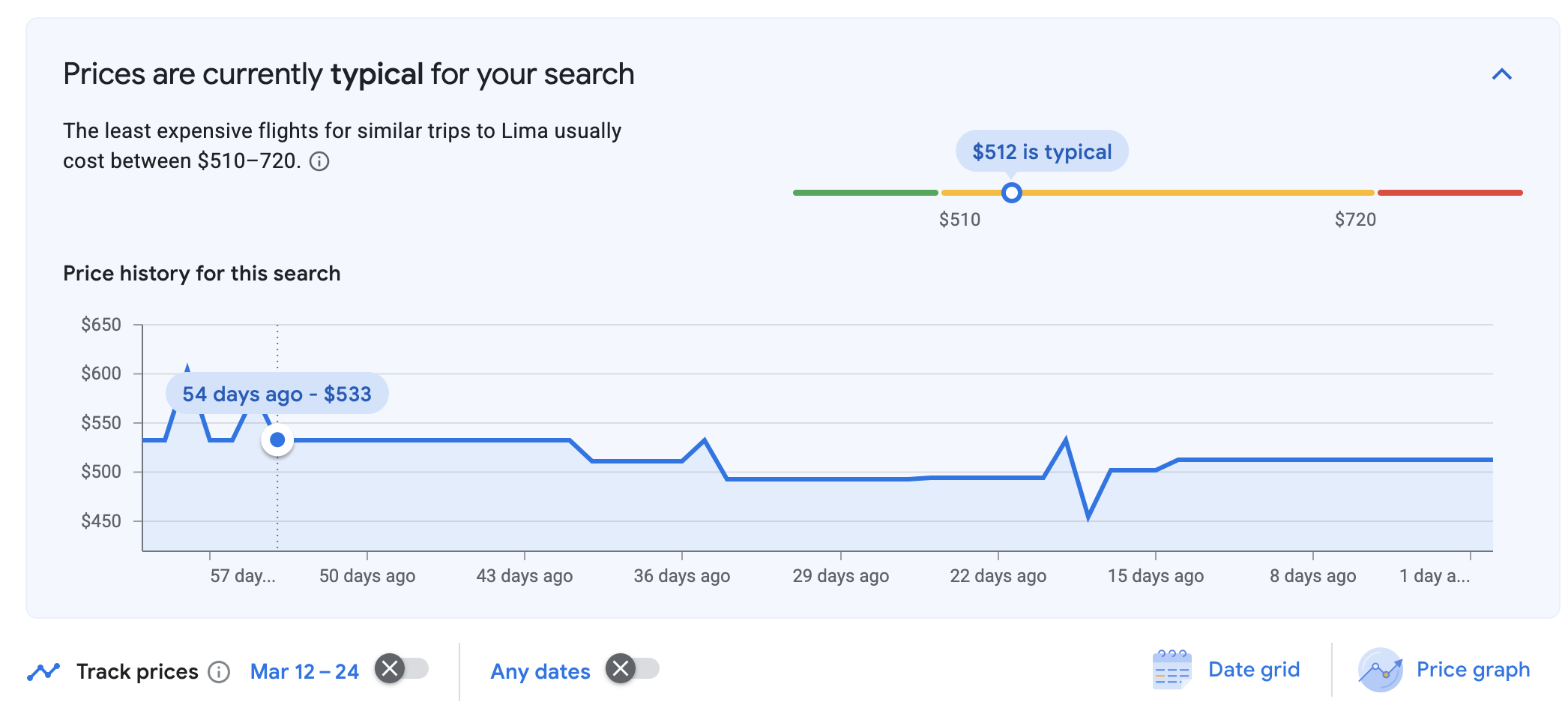
In the example above, Google Flights shows that flights to Lima typically fall within a certain price range. You can immediately see where the current price sits compared to what’s normal, instead of relying on gut feeling alone.
This feature has saved me from:
Overpaying out of urgency
Waiting too long for a price drop that was unlikely
Obsessively rechecking the same flight multiple times a week
It also helps shift your mindset from “Is this the cheapest possible price?” to “Is this a reasonable price for this trip?” which is a much healthier way to book flights, especially when you’re planning something meaningful.
I always encourage travelers to look at this price comparison before deciding whether to wait or book. If a price is already typical or on the lower end of the usual range, there’s often no benefit to holding out, especially as your travel dates get closer.
Why Flexible Dates Matter More Than Almost Anything Else
If there’s one factor that consistently impacts flight prices, it’s timing.
Even small shifts, such as leaving one day earlier or later, can make a meaningful difference, especially for long-haul international routes. When I search for flights, I rarely start with fixed dates. I look at a range of days to understand what’s driving the price.
Google Flights makes this easy by showing price calendars and graphs. Instead of guessing or endlessly refreshing, you can quickly see which days are overpriced and which ones are more reasonable.
This flexibility often leads to:
Better arrival times that align with logistics
Avoiding unnecessarily expensive peak travel days
Starting the trip more rested and less rushed
That said, flexibility doesn’t mean giving up what matters to you, and that’s where a lot of online advice goes wrong.
The Cheapest Flights I’ve Ever Booked (And the Myth That Comes With Them)
Some of the cheapest flights I’ve ever booked were a direct result of being flexible, not just with dates, but with destination too.
One of the most extreme examples? I once booked a round-trip flight to Seoul on Christmas for $200.
Seoul wasn’t even on my bucket list at the time.
I didn’t plan that trip months in advance. I noticed a price that made no sense, had flexibility in my schedule, and said yes. That level of freedom, with both time and destination, can absolutely unlock unbelievable flight deals.
But here’s the part most travel blogs don’t talk about:
That level of flexibility is not realistic for most people.
Cheap Flights Myths: Flight Hacks That Don’t Actually Work for Most Travelers
One of the most common “flight hacks” you’ll see online is “Just be flexible with your dates and destination.”
Technically, that advice isn’t wrong. Practically, it ignores real life.
Most travelers:
Have limited PTO
Take one main vacation a year or two
Are emotionally invested in a specific destination
Are traveling for a reason: a group trip, a milestone, a long-held dream
If you’ve been saving for a trip to Peru, Morocco, or Tanzania, you’re probably not thinking “anywhere is fine.” You’re thinking, “I really want to go here, at this time, without blowing my budget.”
And that’s completely valid.
“Being flexible with time and destination can lead to cheap flights, but it’s unrealistic advice if you only have one vacation and one destination your heart is set on.”
This is why I don’t love when flexibility is presented as the ultimate cheap-flight hack. It can make travelers feel like they’re failing when in reality, they’re just living normal lives.
What Realistic Flexibility Actually Looks Like
In real life, flexibility is often subtle and strategic. It might look like:
Leaving one day earlier or later
Flying into a nearby airport instead of the most popular one
Accepting a slightly longer layover for a better fare
Traveling just outside peak dates instead of right in the middle
Including different modes of transportation, like trains or buses, when practical
This is the kind of flexibility I encourage for Trekking Pals travelers. Instead of abandoning the destination they’re excited about, why don’t we make intentional trade-offs that still support the experience they want?
Tracking Flight Prices Instead of Panic-Booking
One of the most underrated features on Google Flights is price tracking, especially on desktop.
Price tracking lets you see how fares move over time. Instead of guessing whether prices will drop, you can watch real trends and make decisions calmly.
I personally track:
All international flights
Any flight that feels unusually expensive
Trips booked more than two months in advance
This approach has saved me thousands of dollars collectively. More importantly, it reduces anxiety. You stop reacting emotionally and start responding strategically. This works when you’re looking for flights about 6 months earlier or more.
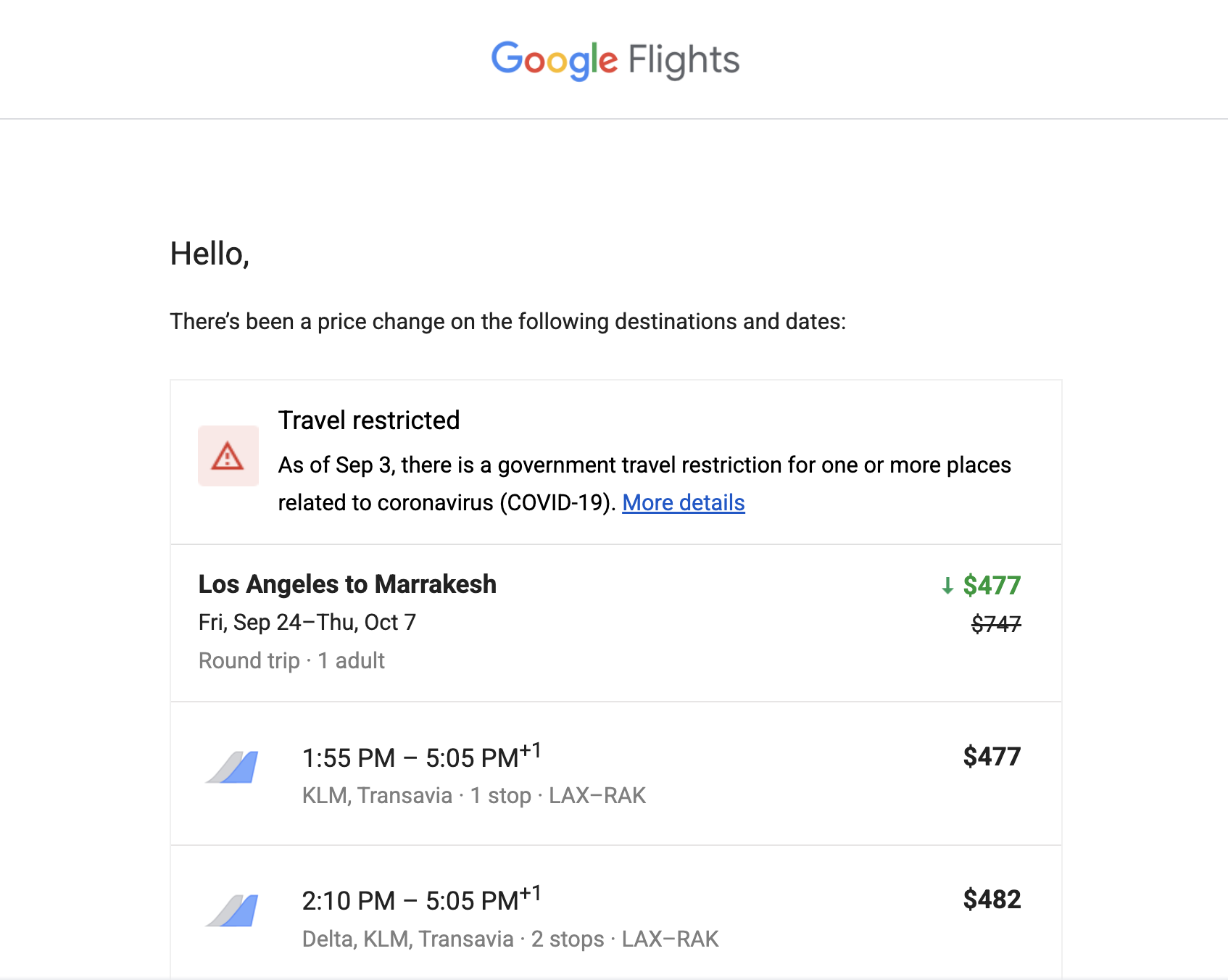
When activating the tracking feature with Google Flights, you will start receiving regular emails with price changes over time. The image above shows a price change from $747 to $477.
When to Book Flights (And When Waiting Backfires)
There’s no universal “perfect” time to book flights, but patterns do exist.
For international travel, I usually start actively monitoring flights six months in advance. For peak seasons or popular routes, that window may need to be earlier.
Waiting too long often backfires. Prices rise, good itineraries disappear, and your options become limited.
At some point, the goal shifts from finding the cheapest flight to finding a reasonable, low-stress one. Peace of mind is part of the cost of travel, and it’s worth budgeting for.
Why the Cheapest Flight Is Often the Most Expensive One
After years of travel and hearing countless stories from travelers, I’ve learned that the cheapest flight often comes with hidden costs.
I’ve seen people:
Miss connections due to tight layovers
Arrive at their destination completely exhausted after 30+ hours of travel
Lose baggage on complex itineraries
Start their trip stressed instead of excited
I learnt over the years not evaluate flights by their price tag. Now I look at the full picture: total travel time, layover length, arrival hour, airline reliability, and baggage rules. Especially when you’re arriving in a new country, traveling for the first time, traveling solo, or joining a group adventure, those details matter.
Sometimes paying a little more upfront leads to a significantly better experience overall.
Booking Directly With Airlines (Why I Almost Always Do It)
Once I’ve found the right flight using Google Flights, I often book directly with the airline, especially for international trips.
When you search for flights on Google Flights, you will be given a list of options with different prices. Some of them are with Airlines directly, and others are with different third-party platforms such as CheapOair, Priceline, Expedia, etc.
Booking direct with the airline usually means:
Easier changes or cancellations
Better communication if something goes wrong
Fewer third-party complications
In my opinion, for big trips, reliability matters more than saving a small amount of money.
Frequently Asked Questions About Cheap Flights
Do flight prices go down at night?
No. Prices change based on demand and algorithms, not time of day. Watching trends over time is more effective.
Are last-minute flights cheaper?
Rarely for international travel. Most routes get more expensive closer to departure.
Is Google Flights cheaper than booking directly?
Google Flights doesn’t sell tickets; it shows options so you can book directly or through approved sellers.
Is it better to book flights on a desktop or a mobile?
A desktop is better for research because it shows price graphs and tracking features more clearly.
Final Thoughts: Skip the Hacks, Learn the Skill
Cheap flights aren’t about tricks or gimmicks. They’re about:
Understanding pricing patterns
Knowing when flexibility helps and when it doesn’t
Making decisions that support the trip you actually want
Using the right search tools, such as Google Flights
That’s how you book flights with confidence. And that’s how I help women travel smarter, calmer, and more intentionally, whether they’re joining a Trekking Pals adventure or planning something entirely their own.